
TRX250r.org

Show Posts

This section allows you to view all posts made by this member. Note that you can only see posts made in areas you currently have access to.


Messages - Uns

Pages: [1] 2
1
Engine and Bottom End / Afco fittings
« on: June 20, 2016, 12:22:47 PM »
Quote from: sangheraent;66428
I know I know I posted about buying a CBR radiator but I have been doing some research and it seems like afco is a bit more popular, I was wondering if anyone knows which fittings I will need to run an afco if I decide to go that route? I have to order it online and pick it up on my way to oregon so I cant just take it to an auto parts store I have to have the fittings before hand. I found the link for the rad hoses.

Mine didn't come with fittings a few years back.   You basically need to go from 1/2" npt male to 1/2"/-12an hose barb fitting.  A fancy way to do this would be:
https://www.summitracing.com/parts/SUM-220246/
into
https://www.summitracing.com/parts/AER-FBM1525/

There are tons of options, including different curves for the hose barb fitting depending.  I needed a 90 and a 45 degree for my setup(you wont be able to use the stock lower hose.)  You could save a bunch of money and just go:
https://www.summitracing.com/parts/der-15712/overview/

That straight and simple one above says aluminum(which I would definitely stick to similar metals), but looks brass?  For the price, could try them out, or go to a local specialty hose shop.

and I used some of this for the threads:
https://www.amazon.com/Permatex-80632-Thread-Sealant-PTFE/dp/B000HBNTGY/ref=sr_1_fkmr0_1?ie=UTF8&qid=1466438833&sr=8-1-fkmr0&keywords=pipe+sealant+npt+permatex

I like the "fancier" setup because I can change directions on the fittings by replacing the -12an to hose barb fitting, and they also rotate 360.  I'd not want to have to disassemble the NPT fitting, the threads are pretty much crap.
2
Suspension and Chassis / Chain guide problem
« on: June 09, 2016, 12:40:05 AM »
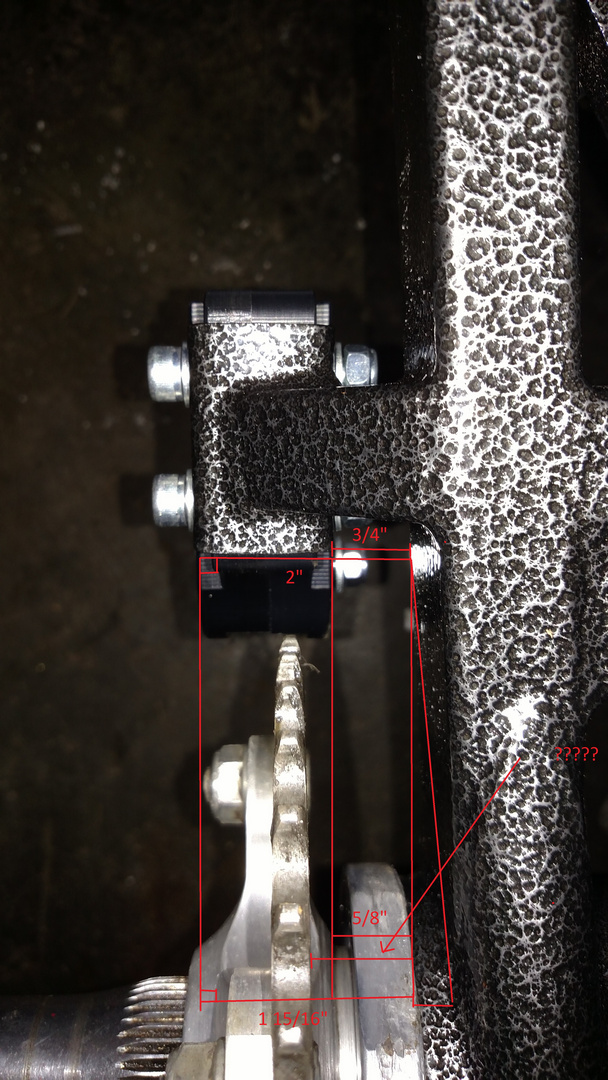
The picture I attached has perspective issues, but those seem like your numbers so far Troy?  Sorry for terrible paint editing.

So, we got almost exactly 2 inches from both the edge of the swingarm at the point of the guide, and the edge of the carrier clamp tube?  And a very similar number matching the inside numbers(off by 1/8 is probably measurement error).

Having this same exact picture from multiple different people, with the measurements filled in(including to the sprocket from that carrier clamp lip part of the swingarm) would go really far in showing if LSR screwed up or not.


3
Suspension and Chassis / Chain guide problem
« on: June 08, 2016, 03:31:17 PM »
As long as they are aligning the front and rear sprockets, and assuming stock sized parts for the carrier and axle, there are only one reason the guide would have to be moved outward 1/2": If that left tube coming from the pivot point was moved right 1/2" at the point where the guide is, and only in relation to the rear carrier tube.

So, I guess the best measurement would be, rear carrier tube edge(part that clamps the carrier) to outside edge of guide mount.  If that number is different on TheSmith's bike, then the swingarm wouldn't work with the rest of his parts either.

4
Suspension and Chassis / Chain guide problem
« on: June 08, 2016, 02:58:38 PM »
Quote from: Troy;68148
They just got back to me, double check their measurements and assure me it was built correctly, so maybe something is wrong on my end, (tweaked frame or motor mounts not sure).  Can't find anything obvious though

From your pictures, it really doesn't look like your chain guide will fit unless you spacer out your rear sprocket from the carrier.  Maybe you could get measurement numbers from LSR on the edge of swingarm carrier area to sprocket and carrier to sprocket?

The whole thing doesn't make much sense to me.  What could they have changed that would require a 1/2" change in guide position, except for changing where the rear sprocket lines up relative to the swingarm by 1/2"?  It'd make sense if, say, they reduced the overall width left-to-right of the arms by 1" symmetrically at the rear and had to add 1/2" to make up for width loss.

It'd be a very interesting measurement to know the difference between Troy's and TheSmith's right-to-left and right-to-outer-edge-of-chain-guide widths, at the chain guide point.

5
Suspension and Chassis / Chain guide problem
« on: June 07, 2016, 01:32:45 PM »
Both carrier and axle are LSR, bought around two years ago.  I'd figure that I'd have as good of a chance as anyone to have it line up with all the LSR stuff I have.

I went cheap and picked up this:
http://www.ebay.com/itm/1986-1987-Honda-TRX-250R-Lonestar-Chain-Guide-Set-/120979323810?

We'll see if I regret that guide set or not.

6
Suspension and Chassis / Chain guide problem
« on: June 07, 2016, 11:30:33 AM »
Interesting and worrying thread.  I just ordered a LSR +4 last week on ebay, along with the cheaper $75 "Lonestar chain guide set".  Not sure if I'll get it in a week or if it's a "Special order" month long wait.  I'll report back if I run into any fitment issues

7
Carburetor, Intake, and Exhaust / Reed-Less 2 stroke intake valve
« on: October 07, 2015, 03:41:00 PM »
Quote from: JesseA420;59565
UNS too much rant, u seem like u have an agenda to discredit this idea.

maybe... maybe not? says who?

nothing wrong with getting excited about innovative thinking.

You got me!  I'm actually an agent from the two stroke reed lobby here to destroy these reed-less heathens and continue to collect my millions in two stroke reed sales!

Really though, I just enjoy science, physics, and have thought of a similar idea before.  After doing 10 minutes of research, learned that valves like this one allow a LOT of backflow, and only "increases resistance" to the backflow, never stopping it, which is not what you want.

The Tesla valve has been known about for literally 100 years.  This design is, in my non-expert opinion, an inferior design to the actual Tesla patent(which utilizes a directional flow barrier in the "loopback" area rather than an open loopback, which is most likely inferior.)  you can see the similarity in the image at: https://en.wikipedia.org/wiki/Tesla_valve

And to expand even further on what Jerry said, not only does the device not have to function as described in the patent, the device doesn't even have to EXIST to get a patent.  All we have right now is a 3d computer model and a patent pending without a number(which reminds me of someone recently, but hell, at least he was shipping actual parts)

All of this being said, I really do hope it works.  If the canary in the birdcage comes out alive, and is priced similar to a reed valve and a set of reeds, I'll be the first in line to buy two.  I'm just glad I'm not the one with my money on the line, is all...

8
Carburetor, Intake, and Exhaust / Reed-Less 2 stroke intake valve
« on: October 07, 2015, 12:43:04 PM »
While I want to be jumping out of my seat at the thought of never replacing worn out and expensive reeds again, I really doubt this is going to add power.  It MIGHT make the same, and I think likely it will be a trade-off of power for simplicity, like usual.

I had thought about a Tesla valve for a reed cage a long time ago after running across them, but even Tesla valves, which look like they impede the reverse flow better than this intake will, only offer a ~10 fold reduction in flow per "stack" used.  That resistance does not increase over time, like a "shutting" reed valve will, from "open" to infinity.

The one potentially redeeming feature of this valve is that there is no reed resistance to overcome, though there is momentum in the reverse flow of this system that the new incoming fresh charge has to overcome, so that might be a wash.

And, even the big boys doing modern innovation on two strokes are still using reeds.  Thinking that "The guys behind the smart carb came up with it, and they are amazing!" isn't taking into account the millions in R&D being dumped into clean two stroke tech with direct cylinder injection and 150:1 oil ratios using targeted injection points.  If this was the best way to design an intake valve, they would have thought of it, done it and advertised the hell out of it.

And, all we have is a side-cut view of a 3d model on a computer.  I'll get much more excited when they show the side-cut of an actual valve, some flow simulations, and dyno graphs showing, at minimum, no horsepower loss.

/WetBlanketMode off

9
Carburetor, Intake, and Exhaust / Reed-Less 2 stroke intake valve
« on: October 06, 2015, 06:34:50 PM »
Looks like a simpler Tesla valve.  Pretty low surface area for flow.  Will probably allow more back-pressure to come through the carb, similar to a broken reed.  Will be interesting to see if it works.

10
ATC250R / Sick Missile!
« on: September 05, 2015, 12:03:03 PM »
Sucks to have a $6000 engine in that thing that's just going to have to be taken out and sent to a real builder.  Especially a 330...

11
Suspension and Chassis / Alternative Rear brake Caliper??
« on: April 16, 2015, 06:04:23 PM »
Everything on the rear but the swinger is straight from LSR last year.  I had my stock brake caliper on there for a while, so it can't be too far off.

Really, the moral of the story is go slow and test fit often!

12
Suspension and Chassis / Alternative Rear brake Caliper??
« on: April 15, 2015, 05:06:04 PM »
Quote from: Langbolt;53191
Yes! Look at the pic and compare it to your bracket.....where the "Bracket Sub Assembly" touches the mounting bracket...that surface of the "Bracket Sub Assembly" has to be machined down to enable the caliper to align with the rotor properly.

Looking at the pic for direction....I filed down the LEFT side of the bracket.....not the right (rotor side)

Let me know if you need a better Pic

:)


It's not a big deal, but it is weird.  I filed down the left side some, but only until it looked like the rotor was centered on the rotor notch of the caliper.  The right(rotor) side is on the same plane as the left-most side of the rotor notch, and my rotor bolts stick out a good bit.  This basically means that I have to file down the right(rotor) side of the bracket.  

I don't see any way that all the material you removed was from the left side, and not from the right.  This is all mostly for clarity for others, as I'm clunking through it slowly myself, but see the pic below to see what I'm talking about.


13
Suspension and Chassis / Alternative Rear brake Caliper??
« on: April 14, 2015, 05:26:23 PM »
Quote from: Langbolt;52025
Bracket Complete


Just need to make the spacer to move the rotor out from the Swingarm.....or machine the CRF Bracket to get it to fit.

I'm thinking the SPACER would be easier and I could weld it to the bracket to make it one piece.

Stay tuned


I ordered the partzilla part in the post above, HP-45150-KZ4-J21, but I'm running into an issue with the thickness of the "bracket sub assembly" part where it still rubs against the rotor's mount bolts after filing down the bracket's mount points.

Your bracket above looks at least a quarter inch thinner than mine, with tons of daylight between the rotor bolts and the new bracket.  Did you file down the face of the rotor side of that bracket for clearance?

14
Quote from: rablack21;53090
While I appreciate you putting things in layman's terms for us simple folk, but I happen to be a mechanical engineer as well that happens to study, design, and spec cooling systems for a living. I also use theory to guide my design work and use test results to guide changes and make refinements to original designs. I also was taught theory in the engineering college that I went to and have traveled around the world with my work due to the engineering experience and capacity that I have.

You are right about the heat transfer being proportional to the delta T at the rated rpm (not speed), at a given airflow, that the engine produces it's highest heat rejection requirement, and the cooling system is balanced to meet this heat rejection based on this value. So, something we agree on.

While I appreciate you trying to save me money and time with your 40 years of engineering experience and testing on this exact situation, I respectfully disagree with your theoretical outcome and will continue to pursue this and do some actual testing.  A destination that you and Honda arrived at? Again, quite presumptuous.  Honda spec'd this cooling system for a 246cc engine, not anything larger. So I'm reasonably sure (not completely sure, because I don't want to be presumptuous) that Honda didn't study this specific application.

I'm no mechanical engineer, but it seems delta T is the difference in temperature between the radiator and the engine.  In a zero air movement environment, your delta T should be theoretically zero, no matter what speed above a trivially low rpm you run the engine at.  It is in the heat exchange provided by the radiator that delta T increases.

What Jerry is saying is the water velocity's impact on the engine temperature is proportional to the difference in temperature between the radiator and the engine.  The MPH-only situation might be overly simplistic, and there would be a major difference between say 10krpm 2nd gear at 30 and 2krpm 6th gear at 30, but the speed of air passing by the radiator is an important component.

At these different speeds, if the "delta T" is zero, then a new impeller is pretty pointless.  If your delta T is 50, then it's probably worth it.  10 sounds like a decent ballpark figure.

This data, at different speeds, is exactly what I'd think any engineer would do before designing a "better" component.

Unless you just want your mouse trap to have death spikes and some mouse poison just to make extra sure.

15
Lounge / Running DC without battery
« on: October 09, 2014, 09:00:35 PM »
For rectifiers, the easiest way to think of it is:  No one wire on the regulator/rectifier can ever share a path with another wire.  You can think of the chassis as one big wire, and you have to "float" the other three wires, however possible.  Obviously, the "cheapest" way is to float the AC at the stator, as this requires the least amount of wire(two couple-feet long wires to the rectifier, one 10+feet long DC wire to the accessories.)

Also, diodes will fail to behave as expected at higher frequency AC, and it is even possible to ruin slow/cheap diodes/LEDs with high frequency AC.

(Long boring explanation below)

As you rev your engine, you are increasing the frequency of the AC generated. Diodes have a reverse recovery time, where they behave as nearly short circuits for a short period while voltage is presented in the reverse direction across them. This isn't an issue at lower frequencies, as the amount of time the diode spends in this reverse recovery time is much less than the amount of time it takes for the AC signal to swing deep into the reverse polarity stage.  At high frequencies, the time the diode spends in recovery time could equal or be greater than the time the AC signal spends in reverse polarity.  This means that the diode has to pass whatever forward current it was designed for, and now is also passing extra (possibly large) current in the reverse direction that all adds to the amount of heat the thing has to dissipate.  

Luckily, in the case of a cheapo light bar, your LEDs are most likely in series with a high value resistor, which is probably why your bar still works after a cooling down period instead of being a bad paperweight.

Most likely, the Banshee's system is producing a lower frequency AC than the 250r.  That, or your buddy got slightly better spec LEDs in his tail light.

TLDR: Rectify your AC with the right tools for the job!

Pages: [1] 2