Additionally, the genus of the flame front surface - that is the degree of 'wrinkling' - which usually has a fractal nature (you know, those weird, seemingly random yet oddly patterned computer drawings), is increased greatly by turbulence, which leads to an increased surface area of the flame front. This increase in surface area is then able to burn more mixture since more mixture is exposed to the larger flame front surface. This model of combustion is called the "fractal burning model" (Goudin, F.C. et al. 1987, Abraham et al. 1985). The effects of this are observed in so-called "Schlieren pictures," which are high-speed photographs taken though a quartz window of a specially modified combustion chamber (Fig. 1, above).
Schlieren pictures show the various stages of the combustion process, in particular the highly wrinkled and turbulent nature of the flame front propagation (initially called the flame 'kernel').
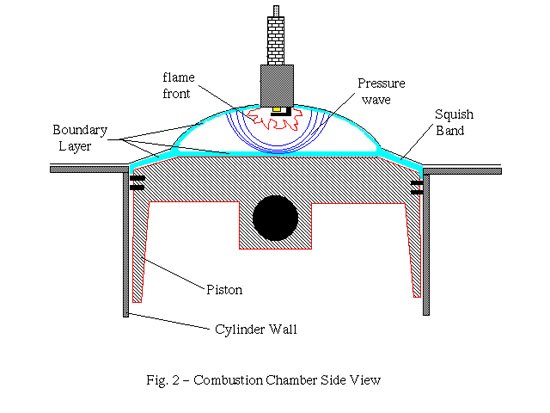
A higher degree of turbulence, and hence a higher "effective" flame front propagation velocity can be achieved with a so-called squish band combustion chamber design. Sometimes a swirl-type of induction process, in which the incoming mixture is rotating quickly, will achieve the same goal of increasing the burn rate of the mixture.
As a general rule-of-thumb the pressure rise in the combustion chamber during the combustion phase is typically 20-30 PSI per degree of crankshaft rotation. Once the pressure rises faster than about 35 PSI/degree, the engine will run very roughly due to the mechanical vibration of the engine components caused by too great of a pressure rise. Sometimes, the pressure wave can be strong enough to cause a self ignition of the fuel, where free radicals (e.g. hydroxyl or other molecules with similar open O-H chains) in the fuel promote this self ignition by the pressure wave.As a general rule-of-thumb the pressure rise in the combustion chamber during the combustion phase is typically 20-30 PSI per degree of crankshaft rotation. However, this can still occur even without the presence of free radicals; it just won't be quite as likely to happen. This is why high octane fuels, with fewer of these active radicals, can resist detonation better. However, even high octane fuel can detonate - not because of too many free radicals - but because the drastic increase in cylinder pressure has increased the local temperature (and molecular speed) so high that it has reached the ignition temperature of the fuel. This ignition temperature is actually somewhat lower than that of the main hydrocarbon chain of the fuel itself because of the creation of additional radicals resulting from the break-up of the fuel's hydrocarbon chains in intermolecular collisions.
Detonation usually happens first at the pressure wave's points of amplification, such as at the edges of the piston crown where reflecting pressure waves from the piston or combustion chamber walls can constructively recombine - this is called constructive interference to yield a very high local pressure. If the speed at which this pressure build-up to detonation occurs is greater than the speed at which the mixture burns, the pressure waves from both the initial ignition at the plug and the pressure waves coming from the problem spots (e.g. the edges of the piston crown, etc.) will set off immediate explosions, rather than combustion, of the mixture across the combustion chamber, leading to further pressure waves and even more havoc. Whenever these colliding pressure fronts meet, their destructive power is unleashed on the engine parts, often leading to a mechanical destruction of the motor. The pinging sound of detonation is just these pressure waves pounding against the insides of the combustion chamber and piston top. Piston tops, ring lands and rod bearings are especially exposed to damage from detonation. In addition, these pressure fronts (or shock waves) can sweep away the unburned boundary layer (see figure 2 above) of air-fuel mix near the metal surfaces in the combustion chamber.