TRX250r.org

Author Topic: cylinder plating  (Read 3374 times)

Offline jcs003

cylinder plating
« on: January 31, 2014, 09:12:55 AM »
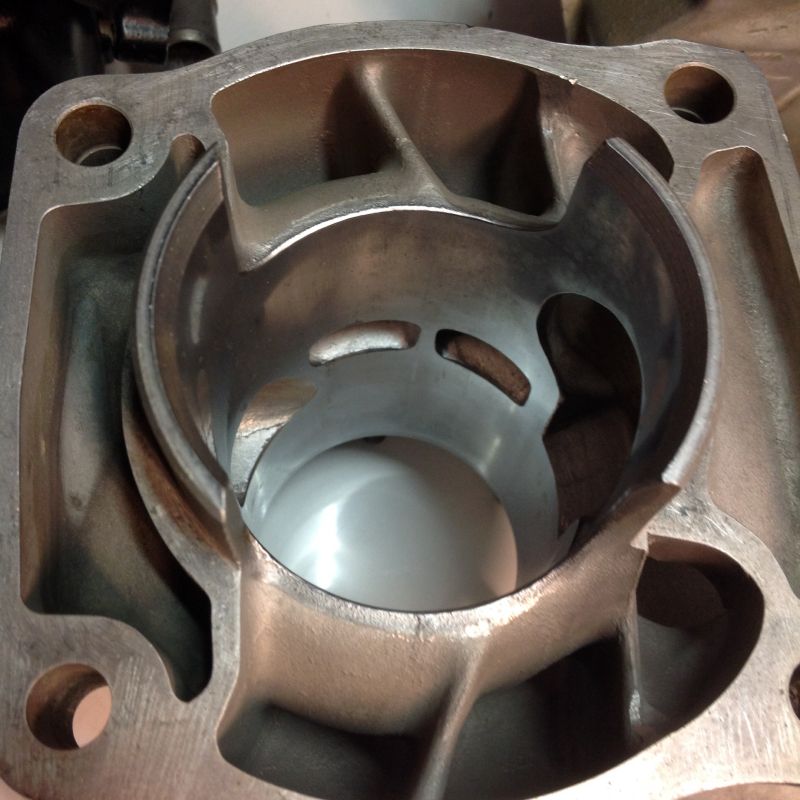
has anyone nikasil'd their OEM cylinder?  do you think it is worth it?

thanks john

Offline rsss396

cylinder plating
« Reply #1 on: January 31, 2014, 09:25:21 AM »
well if you asked Mr250sx he will probably tell you no, but that was based on Millennium screwing up his finished bore size and sizing with .010 of clearance instead of the .0035
He was also unaware that the cylinder goes thru a acid bath and sandblasting ruining his cylinder polishing that had been done the year before and now again when they redo the cylinder.

He wanted to not lose his port job that had worked so well for him so he sent it off to be plated, unfortunately its been a nightmare for him but hopefully once he gets it all back together it will be durable and worth it in the long run
Anyone looking for a great builder I highly recommend the following.
For CP products dealers I would recommend:
Arlan at LED(site sponsor), Pete Schemberger at Hybrid Engineering, Mat Shearer at Shearer Custom Pipes, Dennis Packard at Packard Racing, and Nate McCoy of McCoys Peformance.

Other great builders I also would recommend: Neil Prichard, Jerry Hall, Bubba Ramsey and James Dodge.

Online Jerry Hall

cylinder plating
« Reply #2 on: January 31, 2014, 10:07:51 AM »
Quote from: jcs003;24165
has anyone nikasil'd their OEM cylinder?  do you think it is worth it?

thanks john

There is not any heat transfer improvement, just a more durable cylinder wall surface.


I see three advantages to plating the bore surface in an aluminum casting.


Listed in the order that I believe plating has it's major benefit.

1.  Improved heat transfer to the cooling medium over that of a sleeved cylinder.

2.  Reduced bore distortion as the cylinder changes temperature.

3.  A surface that is more resistant to ware.

4.  A slight reduction in friction.

Offline udontknowme

cylinder plating
« Reply #3 on: January 31, 2014, 11:07:15 AM »
i think jerry summed it pretty good. me personally i wouldnt plate a oem sleeve but thats just me. but i would like to make a aluminum sleeve for it and plate that and see how it works. a one piece aluminum casting with nikisil is probly the best way like jerry mentioned
to much power is almost enough

Offline jcs003

cylinder plating
« Reply #4 on: January 31, 2014, 11:21:38 AM »
thanks for the info guys.  answered my questions and hopefully answered it for others.

john

Offline Dezsled

cylinder plating
« Reply #5 on: January 31, 2014, 11:21:55 AM »
Is there any kind of maintenance involved when replacing pistons? I mean since it's nikasiled no deglazing etc?

I had a kx cyl on a Tecate and don't remember doing anything for the electrofusion bore surface when replacing the piston.


\'04 Roll LOBO II TRX250R
\'06 LTR450
\'87 HPR LT500
\'87 LT500
\'85 & \'86 LT250
\'86 & \'87 TRX250R
\'07 & \'09 Husqvarna TE450
\'00 CR125R
Parts & more parts

Online Jerry Hall

cylinder plating
« Reply #6 on: January 31, 2014, 01:34:17 PM »
Quote from: Dezsled;24180
Is there any kind of maintenance involved when replacing pistons? I mean since it's nikasiled no deglazing etc?

I had a kx cyl on a Tecate and don't remember doing anything for the electrofusion bore surface when replacing the piston.


If the bore is straight, round and does not have scratches, I do not recommend honing a plated cylinder.  ALWAYS measure the cylinder and piston to determine the cylinder condition and verify that the piston to cylinder wall clearance is within spec.  


De-glazing will reduce the time it takes the ring and piston to break-in, but it will also reduce piston and ring life.  Nikasil is a very hard material and a new or freshly honed cylinder is much more abrasive than one that has already worn out a piston and set of rings.  

Some factory service manuals say to use a ball hone to deglaze the cylinder before installing new rings or piston.  I do not think that recommendation came from the engineering or manufacturing department but from someone with limited mechanical and machining experience that was hired to help write service manuals.  If you will think about what material is removed and the process of what happens to the surface of the bore while using a ball hone vs a rigid mandrel type hone, it will become obvious why a ball hone should never be used on anything other than to remove rust from inside an old water pipe or to clean sewer pipe.  

There are not very many shops that will spend the money to buy good honing equipment.  A good ball hone typically cost under $100.00.  A Sunnen honing mandrel loaded with diamond stones cost a little over $1000.00 and it only fit cylinders that are within a few millimeters of its size. It takes a whole cabinet of these costly mandrels to cover the range of cylinders sizes where 3 or four ball hones will cover the same range of sizes.

 

Sitemap 1 2 3 4 5 6 7 8 9 10 11 12 13 14 15 16 17 18 19 20 21 22 23 24 25 26 27 28 29 30 31 32 33 34 35 36 37 38