TRX250r.org

Author Topic: The Mystery of Detonation  (Read 2596 times)

Offline rsss396

The Mystery of Detonation
« on: July 30, 2013, 04:43:50 PM »
This is part of a "Wrenching with Rob" series,  in which Vintage Editor and Technical Writer Robin Tuluie will discuss,  in depth, technical and theoretical topics that make motorcycles  function.  Since the previous Wrenching With Rob, Chemical Soup: The Meaning of  Gasoline we've been besieged with questions and comments regarding the  combustion process occurring in an engine. In particular, the discussion  focused on the problem of detonation, commonly referred to as "knock,"  which is a very serious and detrimental problem when it occurs - usually  the pressures exerted onto the piston top during detonation are much  larger (but of a shorter duration, like a pressure spike) than the mean  combustion pressure. Nevertheless they are very detrimental to engine  life, as the continual high shock loading of the piston, rod, crankshaft  and bearings is quite destructive.  
Detonation is the result of an amplification of pressure waves,  such as sound waves, occurring during the combustion process when the  piston is near top dead center (TDC).  
The actual "knocking" or "ringing" sound of detonation is  due to these pressure waves pounding against the insides of the  combustion chamber and the piston top, and is not due to 'colliding  flame fronts' or 'flame fronts hitting the piston or combustion chamber  walls.'
 Let's look in some detail at how detonation can occur during the combustion process:
 First, a pressure wave, which is generated during the initial  ignition at the plug tip, races through the unburned air-fuel mix ahead  of the flame front.  Typical flame front speeds for a gasoline/air  mixture are on the order of 40 to 50 cm/s (centimeters per second),  which is very slow compared to the speed of sound, which is on the order  of 300 m/s. In actuality, the true speed of the outwards propagating  flame front is considerably higher due to the turbulence of the mixture.  Basically, the "flame" is carried outwards by all the little eddies,  swirls and flow patterns of the turbulence resident in the air-fuel mix.  This model of combustion is called the "eddy burning model" (Blizzard  & Keck, 1974).
Anyone looking for a great builder I highly recommend the following.
For CP products dealers I would recommend:
Arlan at LED(site sponsor), Pete Schemberger at Hybrid Engineering, Mat Shearer at Shearer Custom Pipes, Dennis Packard at Packard Racing, and Nate McCoy of McCoys Peformance.

Other great builders I also would recommend: Neil Prichard, Jerry Hall, Bubba Ramsey and James Dodge.

Offline rsss396

The Mystery of Detonation
« Reply #1 on: July 30, 2013, 04:44:27 PM »
Additionally, the genus of the flame front  surface - that is the degree of 'wrinkling' - which usually has a  fractal nature (you know, those weird, seemingly random yet oddly  patterned computer drawings), is increased greatly by turbulence, which  leads to an increased surface area of the flame front. This increase in  surface area is then able to burn more mixture since more mixture is  exposed to the larger flame front surface. This model of combustion is  called the "fractal burning model" (Goudin, F.C. et al. 1987, Abraham et  al. 1985). The effects of this are observed in so-called "Schlieren  pictures," which are high-speed photographs taken though a quartz window  of a specially modified combustion chamber (Fig. 1, above).
 Schlieren pictures show the various stages of  the combustion process, in particular the highly wrinkled and turbulent  nature of the flame front propagation (initially called the flame  'kernel').
 A higher degree of turbulence, and  hence a higher "effective" flame front propagation velocity can be  achieved with a so-called squish band combustion chamber design.   Sometimes a swirl-type of induction process, in which the incoming  mixture is rotating quickly, will achieve the same goal of increasing  the burn rate of the mixture.
 
As a general rule-of-thumb the pressure rise in the combustion  chamber during the combustion phase is typically 20-30 PSI per degree of  crankshaft rotation. Once the pressure rises faster than about 35  PSI/degree, the engine will run very roughly due to the mechanical  vibration of the engine components caused by too great of a pressure  rise. Sometimes, the pressure wave can be strong enough to cause a self  ignition of the fuel, where free radicals (e.g. hydroxyl or other  molecules with similar open O-H chains) in the fuel promote this self  ignition by the pressure wave.As a general  rule-of-thumb the pressure rise in the combustion chamber during the  combustion phase is typically 20-30 PSI per degree of crankshaft  rotation. However, this can still occur even without the presence  of free radicals; it just won't be quite as likely to happen. This is  why high octane fuels, with fewer of these active radicals, can resist  detonation better. However, even high octane fuel can detonate - not  because of too many free radicals - but because the drastic increase in  cylinder pressure has increased the local temperature (and molecular  speed) so high that it has reached the ignition temperature of the fuel.  This ignition temperature is actually somewhat lower than that of the  main hydrocarbon chain of the fuel itself because of the creation of  additional radicals resulting from the break-up of the fuel's  hydrocarbon chains in intermolecular collisions.
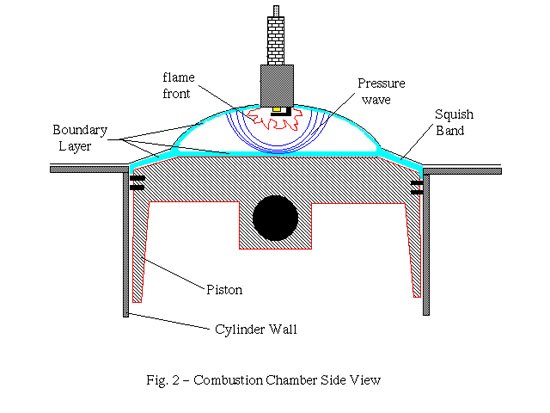
 Detonation usually happens first at the pressure wave's points of  amplification, such as at the edges of the piston crown where reflecting  pressure waves from the piston or combustion chamber walls can  constructively recombine - this is called constructive interference to  yield a very high local pressure. If the speed at which this pressure  build-up to detonation occurs is greater than the speed at which the  mixture burns, the pressure waves from both the initial ignition at the  plug and the pressure waves coming from the problem spots (e.g. the  edges of the piston crown, etc.) will set off immediate explosions,  rather than combustion, of the mixture across the combustion chamber,  leading to further pressure waves and even more havoc. Whenever these  colliding pressure fronts meet, their destructive power is unleashed on  the engine parts, often leading to a mechanical destruction of the  motor. The pinging sound of detonation is just these pressure waves  pounding against the insides of the combustion chamber and piston top.  Piston tops, ring lands and rod bearings are especially exposed to  damage from detonation. In addition, these pressure fronts (or shock  waves) can sweep away the unburned boundary layer (see figure 2 above)  of air-fuel mix near the metal surfaces in the combustion chamber.

Anyone looking for a great builder I highly recommend the following.
For CP products dealers I would recommend:
Arlan at LED(site sponsor), Pete Schemberger at Hybrid Engineering, Mat Shearer at Shearer Custom Pipes, Dennis Packard at Packard Racing, and Nate McCoy of McCoys Peformance.

Other great builders I also would recommend: Neil Prichard, Jerry Hall, Bubba Ramsey and James Dodge.

Offline rsss396

The Mystery of Detonation
« Reply #2 on: July 30, 2013, 04:49:20 PM »
The boundary layer is a  thin layer of fuel-air mix just above the metal surfaces of the  combustion chamber (see figure 2, above).

 Physical principles (aptly called boundary conditions) require that  under normal circumstances (i.e. equilibrium combustion, which means  "nice, slow and thermally well transmitted") this boundary layer stays  close to the metal surfaces. It usually is quite thin, maybe a fraction  of a millimeter to a millimeter thick. This boundary layer will not burn  even when reached by the flame front because it is in thermal contact  with the cool metal, whose temperature is always well below the ignition  temperature of the fuel-air mix.

Only under the extreme conditions of detonation  can this boundary layer be "swept away" by the high-pressure shock front  that occurs during detonation. In that case, during these "far from  equilibrium" process of the pressure-induced shock wave entering the  boundary layer, the physical principles allured to above (the boundary  conditions) will be effectively violated.
 The degree of violation will depend on (a)  the pressure fluctuation caused by the shock front and (b) the adhesive  and cohesive strength of the boundary layer.
 These boundary layers of air-fuel mix remain unburned during the  normal combustion process due to their close proximity to the cool metal  surfaces and act as an insulating layer and prevent a direct exposure  of metal to the flame. Since pressure waves created during detonation  can sweep away these unburned boundary layers of air-fuel mix, they  leave parts of the piston top and combustion chamber exposed to the  flame front. This, in turn, causes an immediate rise in the temperature  of these parts, often leading to direct failure or at least to engine  overheating.  
Scientists and engineers have recently begun to understand  combustion in much greater detail thanks to very ambitious computer  simulations that model every detail of the combustion process (Chin et  al. 1990). Basically, a complete computer model includes a solution to  the thermodynamical problem, that is a solution to the conservation  equations and equation of state, as well as a mass burning rate and heat  transfer model. In addition, a separate code (called a chemical  kinetics code) models the chemical processes which occur during  combustion and sometimes juggles several thousand different chemical  species, some in vanishingly small concentrations! Needless to say these  codes require huge amounts of memory and CPU time that only the largest  supercomputers in the world can provide. They are far beyond the reach  of the private individual and usually only employed by large research  institutions or major car manufactures.
Anyone looking for a great builder I highly recommend the following.
For CP products dealers I would recommend:
Arlan at LED(site sponsor), Pete Schemberger at Hybrid Engineering, Mat Shearer at Shearer Custom Pipes, Dennis Packard at Packard Racing, and Nate McCoy of McCoys Peformance.

Other great builders I also would recommend: Neil Prichard, Jerry Hall, Bubba Ramsey and James Dodge.


Sitemap 1 2 3 4 5 6 7 8 9 10 11 12 13 14 15 16 17 18 19 20 21 22 23 24 25 26 27 28 29 30 31 32 33 34 35 36 37 38